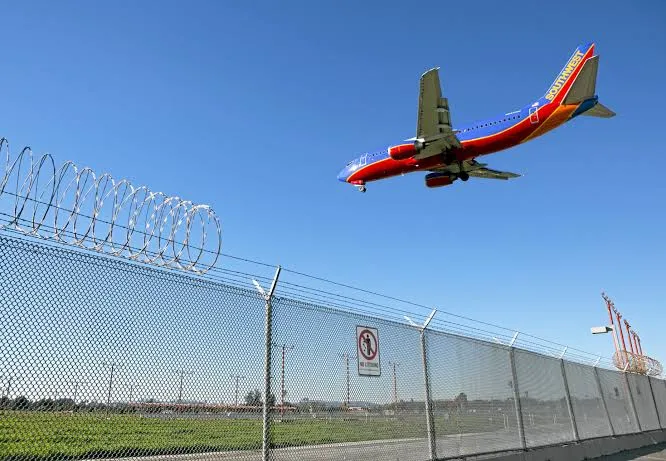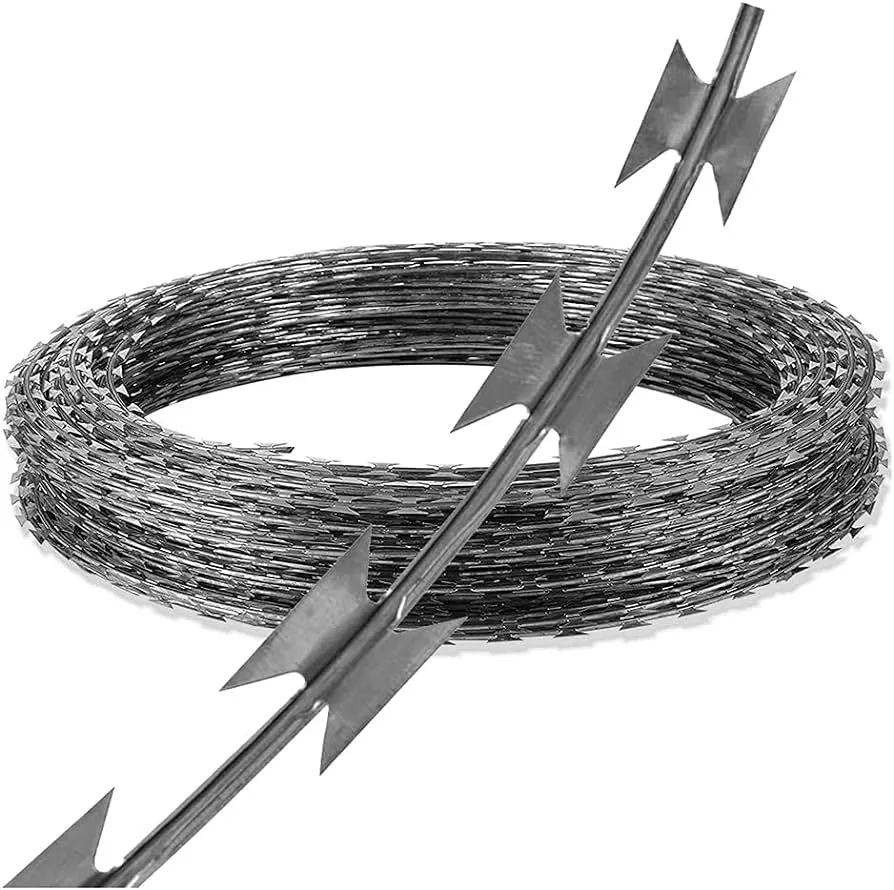

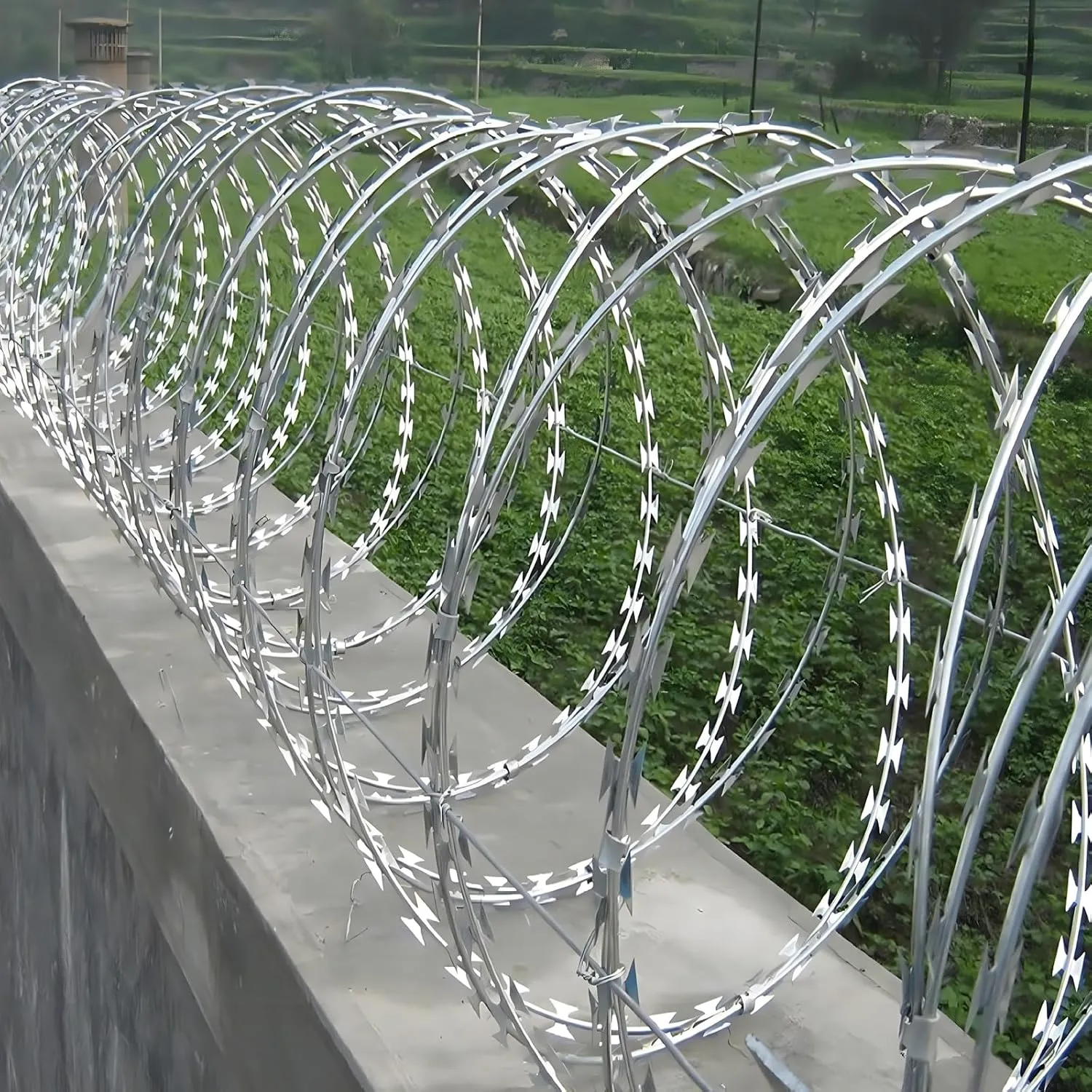
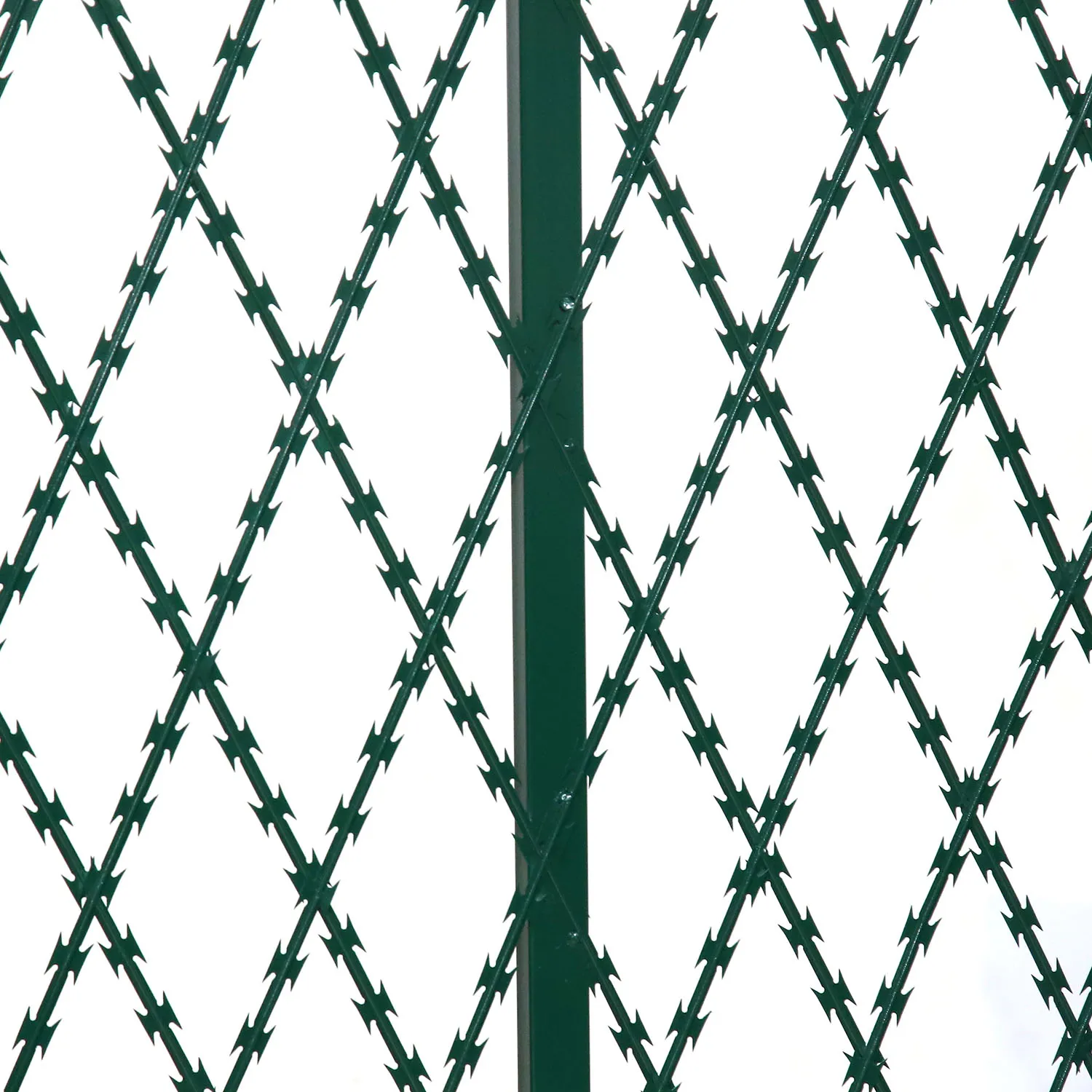
Razor wire fence systems use galvanized or stainless steel razor wire and concertina wire coils to reinforce walls, gates, and perimeter fencing.
| Wire Diamter | 2.0mm, 2.5mm,2.8mm |
|---|---|
| Outside Diameter | 450mm, 500mm, 600mm, 700mm, 800mm, 980mm |
| Length | 10m, 15m,20m |
| Item No. | RZ-001 |
| Blade Type | BTO & CBT |
Estimated Price: USD 2.00 – 30.00 / Linear Meter
A razor wire fence is a high-visibility perimeter barrier formed from a steel core wire and a shaped barbed tape. Depending on the site layout, the material can be supplied as clipped concertina wire, single spiral coils, flat wrap, straight strands, or welded razor mesh. These formats allow planners to reinforce the top of a wall or fence, build a ground-level barrier, or create a dedicated security line.
The system can be produced in galvanized carbon steel for practical corrosion resistance or in selected stainless steel grades for demanding environments. Coil diameter, blade profile, clip quantity, loop count, coating, and extended coverage can be matched to the required installation footprint. This flexibility makes razor wire suitable for industrial compounds, utility sites, warehouses, controlled facilities, transport infrastructure, border projects, and other restricted perimeters.
For project planning, buyers should confirm the supporting fence or wall, required barrier depth, local regulations, exposure conditions, and installation method. Final dimensions and packing can then be specified for efficient handling and consistent deployment on site.
| Configuration | Typical Product Form |
| Concertina coil | Adjacent loops are joined with clips to create a dense, expanding coil for rapid linear coverage. |
| Single spiral coil | An unclipped spiral format suited to straightforward runs and selected wall-top layouts. |
| Flat wrap | Flattened coils sit closer to a wall or fence where projection and installation depth are limited. |
| Straight-line wire | Parallel strands can reinforce an existing fence structure with a slimmer profile. |
| Welded razor mesh | Razor strands are welded into a rigid mesh and may be combined with a frame for panel-style barriers. |
| Item | Available Specification |
| Material | Stainless steel grades 430, 316L, 316, 304L, and 304; or carbon steel |
| Surface treatment | Hot-dip galvanized, electrophoretic coating, or powder coating in selected colors |
| Core wire diameter | 2.0-2.5 mm |
| Blade profiles | BTO series: 10, 12, 18, 22, 25, 28, and 30; CBT series: 60 and 65 |
| Coil diameter range | 450-1500 mm |
| Clips per coil | 3-5 clips, depending on coil design |
| Loops per roll | 30-108 loops |
| Extended length per roll | 10-25 m |
| Approximate roll weight | 5-20 kg |
| Supply forms | Concertina, single spiral, flat wrap, straight line, welded mesh, or project-specific assembly |
| Outside diameter | Circles No. | Length to be covered |
|---|---|---|
| 450 mm | 56 | 8-9 m (3 clips) |
| 500 mm | 56 | 9-10 m (3 clips) |
| 600 mm | 56 | 10-11 m (3 clips) |
| 600 mm | 56 | 8-10 m (5 clips) |
| 700 mm | 56 | 10-12 m (5 clips) |
| 800 mm | 56 | 11-13 m (5 clips) |
| 900 mm | 56 | 12-14M (5 clips) |
| 960 mm | 56 | 13-15 m (5 clips) |
| 980 mm | 56 | 14-16 m (5 clips) |
Razor wire fence systems are commonly considered for controlled industrial, infrastructure, logistics, utility, correctional, defense, and border environments. They may also be used to reinforce warehouse boundaries, plant walls, gates, chain link fencing, welded wire fencing, and other existing perimeter structures.
Application suitability depends on local law, access-control policy, public exposure, maintenance planning, and the load capacity of the supporting structure. A site-specific review should be completed before selection or installation.
Standard compressed-coil packing uses waterproof paper as the inner layer and a woven bag as the outer cover. This method is commonly used for compact BTO-pattern coils and helps protect the bundle during handling and transit.
Rigid carton packing can be selected for large CBT blade profiles such as CBT-60 and CBT-65. The final packing method should be matched to blade type, coil diameter, shipment quantity, and unloading conditions. Package marks and bundle organization can be confirmed with the order details.
1. What is the difference between razor wire and concertina wire?
Razor wire describes the steel core and barbed tape product. Concertina wire describes a coil arrangement that expands along a perimeter; the loops may be clipped together to create a denser barrier.
2. Which materials are available?
Common choices include galvanized carbon steel plus stainless grades 430, 316L, 316, 304L, and 304. Coated finishes may also be specified for selected projects.
3. How do I choose a concertina coil diameter?
The choice depends on installation depth, available clearance, target coverage, supporting structure, and site rules. Common coil diameters range from 450 mm to 1500 mm.
4. Can a razor wire fence be installed on an existing fence or wall?
It can be configured for many existing perimeter structures, including walls, chain link fencing, and welded mesh fencing. The structure and brackets must be checked for condition, spacing, anchoring, and load capacity.
5. Which blade types can be supplied?
The BTO range covers profiles 10, 12, 18, 22, 25, 28, and 30, while the CBT range includes 60 and 65. Selection should consider coil format, required density, handling, and installation method.
6. What details are needed for a quotation?
Provide the preferred material and finish, blade profile, coil diameter, clip count, loops per coil, extended length, total quantity, installation location, and packing requirement.
7. How is the product packed for shipment?
Compressed coils are commonly wrapped with waterproof paper and an outer woven bag. Cartons may be used for selected large blade profiles; packing is finalized according to the order configuration.
8. Are there legal or safety requirements?
Requirements vary by location and site type. Buyers should confirm applicable laws, warning signs, public separation, installer competence, and maintenance procedures before deployment.